







When we experience a wave of modern anxiety—whether triggered by a packed inbox, financial stress, or a high-pressure meeting—our physical body reacts as if we are facing an immediate physical threat. Your brain’s survival center, the amygdala, fires an emergency alarm. This alarm instantly drives your heart rate up, tightens your muscles, and shifts your breathing into a shallow, rapid pattern chest-level pattern.
This shallow breathing pattern creates a frustrating biological loop. Your brain tells your body to breathe quickly because it feels stressed, and that rapid breathing pattern constantly signals back to your brain that you are in danger, keeping you trapped in an anxious loop.
While you cannot easily force your racing mind to “calm down” using willpower alone, you can directly override this physical stress loop by using your breath. In traditional Indian yoga systems, this practice is known as Pranayama—the conscious regulation of life force energy (Prana) through precise breathing patterns. Modern neuroscience confirms that targeted Pranayama techniques stimulate specific cranial nerves, instantly slowing your heart rate and altering your brain chemistry to shift you from panic to calm within minutes.
1. The Vagal Brake: How Slow Breathing Calms the Heart
The core biological secret to dissolving anxiety lies in stimulating the vagus nerve. This long nerve acts as the primary communications highway for your parasympathetic nervous system (your body’s built-in relaxation and recovery response).
When you practice Pranayama techniques that emphasize prolonged, controlled exhalations, you trigger an immediate physiological response known as respiratory sinus arrhythmia. As you exhale slowly, your diaphragm moves upward, slightly reducing the physical volume of your heart chambers. Your brain registers this change and immediately sends a signal down the vagus nerve to apply a gentle “vagal brake.” This nervous system brake slows your heart rate, lowers blood pressure, and sends an clear signal to your brain that you are completely safe.
[Anxious Mind / Shallow Chest Breathing] ──► Amygdala Hyper-Activation
                    │
       (Apply Pranayama Protocol)
                    │
                    ▼
[Prolonged, Controlled Nasal Exhalations] ──► Upward Movement of the Diaphragm
                    │
                    ├──► Activation of the Ventral Vagal Pathway
                    └──► Direct Heart Rate Deceleration ──► Immediate Mental Calm
2. Nasal Resistance and Carbon Dioxide Tolerance
Many people assume that deep breathing means pulling as much oxygen into the lungs as possible by gasping through the mouth. In reality, chronic over-breathing through your mouth actually reduces the amount of oxygen that reaches your brain tissues.
True Pranayama is practiced strictly through your nose. Breathing through your nostrils provides natural air resistance, which forces you to slow down your breath cadence. This controlled resistance allows carbon dioxide ($CO_2$) to build up safely and naturally in your blood. Far from being a mere waste gas, healthy levels of $CO_2$ act as a biological key that frees up oxygen molecules from your red blood cells, allowing that oxygen to enter your brain and body tissues to support deep, systemic relaxation.
The 8-Minute Anxiety-Relief Pranayama Protocol
This simple, three-part breathing routine combines traditional Indian lineage practices with modern autonomic science. Sit comfortably with your spine tall, relax your shoulders down, and close your eyes.
Phase 1: The Calming Humming Breath (Bhramari)
- Duration: 2 Minutes
- The Science: The vibration of humming activates sensory receptors in your throat, drastically increasing parasympathetic vagal tone and releasing nitric oxide, a compound that expands your blood vessels and lowers blood pressure.
How to Practice:
- Place your index fingers gently on the cartilage tabs (tragi) of both ears, lightly pressing them closed to shut out external sounds.
- Take a deep, slow inhalation through both nostrils, expanding your belly and chest.
- As you exhale slowly, keep your lips gently sealed and create a steady, smooth, low-pitched humming sound—like the buzzing of a bee—in the back of your throat.
- Continuous humming until you are completely out of air, then inhale slowly and repeat. Continue this soothing vibration for two minutes.
Phase 2: Alternate Nostril Balance (Nadi Shodhana)
- Duration: 4 Minutes
- The Science: Alternating airflow between your left and right nostrils balances the activity of your brain’s left and right hemispheres, stabilizing your nervous system and lowering ambient anxiety.
How to Practice:
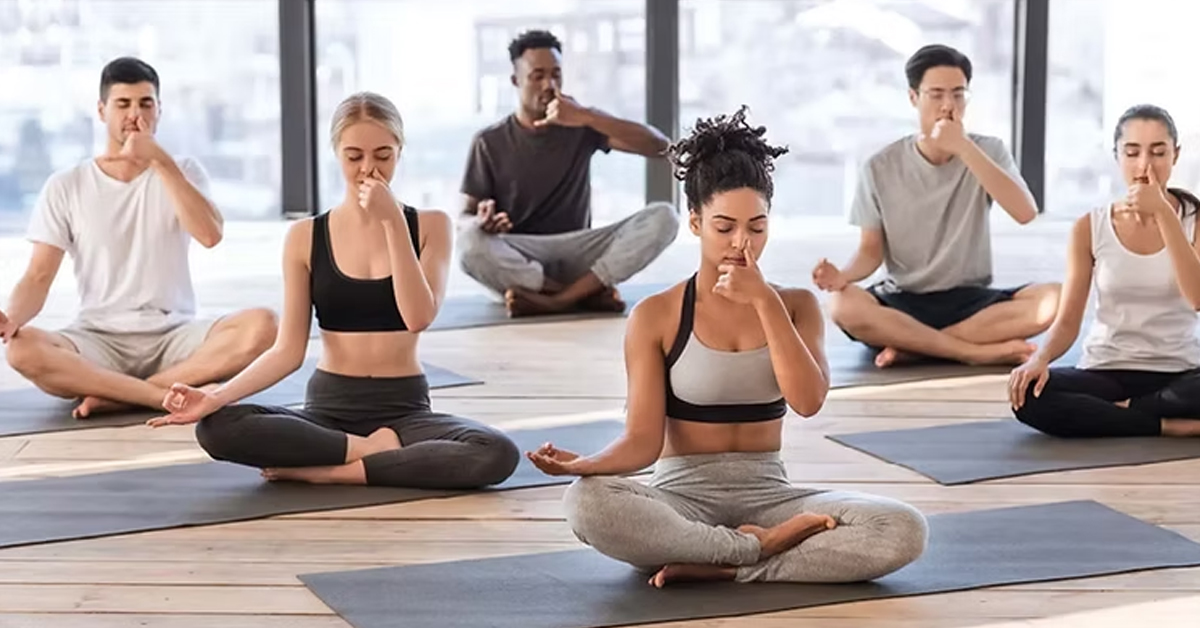
- Rest your left hand comfortably on your knee. Raise your right hand and place your index and middle fingers flat against your forehead between your eyebrows.
- Use your right thumb to gently close your right nostril. Inhale slowly and quietly through your left nostril for a count of 4 seconds.
- Release your thumb, use your ring finger to gently close your left nostril, and exhale fully through your right nostril for a count of 4 to 6 seconds.
- Keep your left nostril closed; inhale through your right nostril for 4 seconds.
- Close your right nostril with your thumb, and exhale through your left nostril for 4 to 6 seconds. This completes one full cycle. Continue this alternating pattern fluidly for four minutes.
Phase 3: The Cooling Straw Breath (Sitali)
- Duration: 2 Minutes
- The Science: Drawing air across your wet tongue creates a direct cooling effect on your oral thermoreceptors, signaling your nervous system to lower your internal stress levels and settle a racing mind.
How to Practice:
- Open your mouth slightly and stick out your tongue, curling the outer edges inward to form a small tube or straw shape. (Note: If your genetics prevent you from rolling your tongue, simply purse your lips into a tight “O” shape).
- Inhale slowly and deeply through your rolled tongue, feeling a crisp, icy-cool sensation pass over your mouth and throat.
- Close your mouth, touch the tip of your tongue to the roof of your mouth, and exhale slowly and completely through your nose.
- Repeat this refreshing cycle for two minutes, letting your mind settle into the cool sensation.
Operational Guidelines for Managing Anxiety Safely
To ensure your breathing practice remains a safe and effective way to ground yourself, keep these three guidelines in mind.
1. Never Force or Hold Your Breath to the Point of Panic
The golden rule of breathwork is that strain defeats the purpose. If you try to force your exhalations to last too long, or if you hold your breath past your comfort zone, you will trigger an internal suffocation alarm in your brain. This alarm causes an immediate spike in adrenaline, making you feel more anxious instead of relaxed. Always keep your breathing feeling smooth, natural, and completely under control.
2. Prioritize Postural Alignment
Never practice Pranayama while slumped forward or slouching on a soft couch. A collapsed posture compresses your abdomen, preventing your diaphragm from moving down fully during your inhalations. Sit near the front edge of a firm chair or cross-legged on a yoga block on the floor. A tall, straight spine creates optimal physical space for your lungs to expand and contract efficiently.
3. Practice Before High-Stress Triggers
Do not wait for a full-blown panic attack to strike before you practice your breathing techniques. Think of Pranayama as a preventive wellness habit. Spend 3 to 5 minutes practicing Alternate Nostril Breathing before you dive into your morning work emails, ahead of a difficult conversation, or right before a large public presentation to keep your nervous system balanced.
Just Saying
Did you know that modern neuroscience recently discovered a tiny cluster of neurons in the brainstem called the pre-Bötzinger complex? This specialized neural structure acts as the brain’s master breathing pacemaker, directly linking your breathing speed to your emotional state. When you choose to slow down your breath using Pranayama, you directly alter the firing rate of this pacemaker, which instantly commands your higher brain centers to turn down your stress levels!
The Final Word
Real, lasting mental peace is never something you have to force your brain to create; it is a natural biological state that you can access at any time by changing how you breathe. Your breath is the ultimate remote control for your nervous system—a powerful tool that travels with you everywhere, completely free of charge. By stepping away from the daily rush, closing your eyes, and guiding your breath through these traditional, scientifically proven patterns, you reclaim control over your body and mind. Stop letting daily stress dictate your internal balance. Step into the deep ease of conscious breathing, celebrate your expanding inner calm, and enjoy the steady strength, health, and confidence that comes with finding your perfect fit.
Disclaimer: The content presented in this article is designed strictly for educational and informational purposes. It is not intended to serve as a substitute for professional medical advice, diagnosis, or treatment. Always consult with a qualified healthcare professional before beginning a new breathwork routine, especially if you suffer from severe clinical asthma, chronic obstructive pulmonary disease (COPD), or acute panic disorders.